Choosing the right BIS 1180 Distribution Transformer requires more than matching a kVA rating. The decision affects energy losses, voltage stability, safety, maintenance, and operating costs for many years. A suitable transformer should match the system voltage, load profile, installation environment, and expected future demand.
Transformer specialist Martin Heathcote offers a useful principle: “The transformer is the heart of the electrical system.” This view keeps selection practical. A unit may meet a catalogue specification yet perform poorly under uneven loading, high ambient temperatures, or frequent voltage changes. Small details matter. Oil quality matters. So does cooling.
Review the required capacity, primary and secondary voltages, frequency, impedance, insulation level, vector group, and tap arrangement. Compare no-load and load losses carefully. Lower purchase cost can hide higher lifetime expenses. Enclosure design, corrosion protection, clearances, earthing, and ventilation also deserve attention, especially in dusty or humid locations.
Ask for routine test reports and confirm compliance with the applicable BIS requirements. Check temperature-rise limits, dielectric strength, leakage performance, and short-circuit withstand capability. Site conditions should be documented, not guessed. A transformer installed near a coastal area needs different protection from one placed inside a dry industrial room.
There is no perfect selection based on one table. Load forecasts can be wrong. Measurements may be incomplete. Therefore, consult a qualified electrical engineer before approval, and verify the manufacturer’s data independently. The best BIS 1180 Distribution Transformer is the one that remains efficient, safe, serviceable, and suitable when real operating conditions become less predictable.
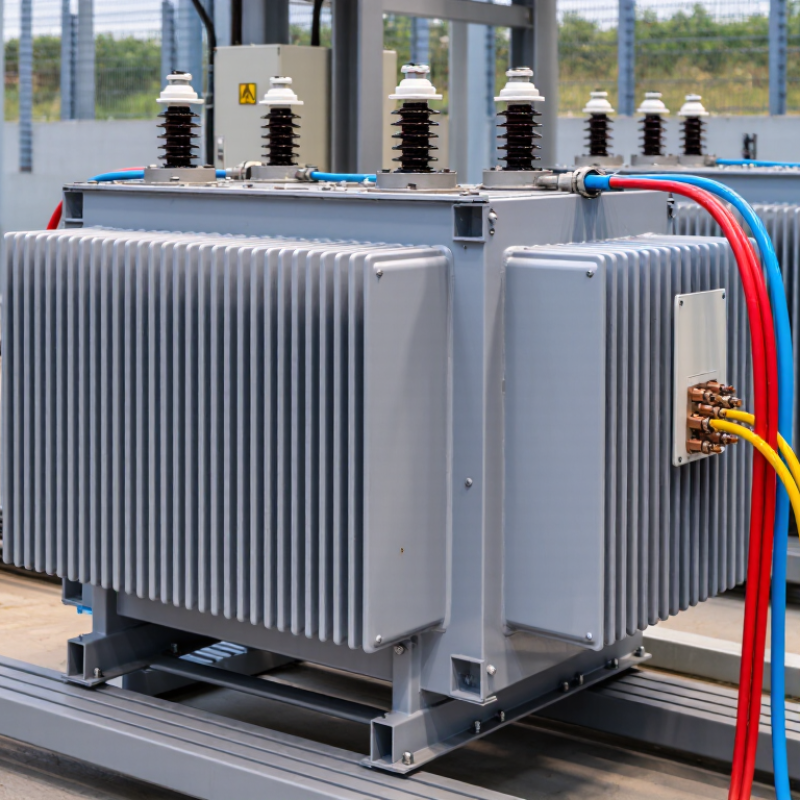
Define BIS IS 1180 Ratings: Voltage, kVA, Frequency, and Phase
How to Choose the Right BIS 1180 Distribution Transformer
Define BIS IS 1180 Ratings: Voltage, kVA, Frequency, and Phase
Selecting a BIS IS 1180 transformer starts with the voltage ratio, not the enclosure size. Common Indian distribution systems use 11 kV, 22 kV, or 33 kV on the high-voltage side, with 433 V or 415 V on the low-voltage side. Confirm the utility’s actual service voltage before ordering. A small mismatch can cause overheating, nuisance trips, or poor motor performance. The Central Electricity Authority’s National Electricity Plan highlights continuing network expansion, making accurate voltage coordination increasingly important.
kVA defines the transformer’s apparent power capacity. It includes both useful load and reactive demand, so do not convert kW directly without checking power factor. Typical IS 1180 ratings include 25, 63, 100, 160, 250, 315, 500, and 630 kVA. Leave practical headroom for motor starting and future connections. Too much spare capacity, however, can increase no-load losses and purchase cost. That trade-off is easy to miss.
Frequency is normally 50 Hz in India; verify it for special installations. Phase selection also matters: single-phase units suit smaller, dispersed loads, while three-phase transformers support balanced industrial and commercial systems. The IEA Electricity 2024 report expects India’s electricity demand to grow by about 6% annually through 2026, so today’s load estimate may age quickly. Check the latest BIS edition, loss limits, insulation level, and test certificates before approval.
Match Transformer Capacity to Load, Diversity, and 20–30% Growth
Choosing a BIS 1180 distribution transformer starts with measured demand, not connected load. Record the site’s maximum fifteen-minute demand across seasons. Then apply diversity, because lifts, pumps, lighting, and office equipment rarely peak together.
For example, a facility showing a coincident peak of 420 kVA should not be sized at 420 kVA. Adding 25% planned growth gives 525 kVA. The next suitable standard rating may be 630 kVA, after checking ambient temperature, installation altitude, cooling, and permissible voltage drop. Leave room for reality.
Growth is not a guess.
The IEA Electricity 2024 report forecasts global electricity demand to rise by an average 3.2% annually from 2024 to 2026. Local industrial expansion can move much faster. A 20–30% reserve therefore offers a practical planning window, but it should be tested against project schedules and feeder data. Check motor starting currents, nonlinear loads, harmonics, and renewable backfeed before confirming capacity. BIS IS 1180 compliance supports consistent design and testing, yet compliance alone cannot correct poor load assumptions. In my experience, the weakest input is often an outdated demand log. Re-measure before ordering.
Compare IS 1180 Efficiency, No-Load Loss, and Load-Loss Limits
How to Choose the Right BIS 1180 Distribution Transformer
IS 1180 selection should begin with verified efficiency, not only purchase price. The applicable BIS edition defines permissible no-load and load-loss limits by transformer rating and efficiency level. No-load loss occurs whenever the transformer remains energized. Load loss rises approximately with the square of current. That difference matters in lightly loaded networks. The Central Electricity Authority reported India’s aggregate technical and commercial losses at about 15.4% in 2022–23. Transformer losses are only one component, but procurement decisions can reduce avoidable technical waste. Keep the figures visible.
Consider a 100 kVA unit as an illustration. A 220 W no-load loss consumes about 1,927 kWh annually, even without customer demand. A 1,250 W full-load loss produces about 1,752 kWh yearly at a 40% load factor. These figures are examples, not compliance limits. Verify the current IS 1180 schedule, test temperature, tolerances, and guaranteed-loss certificate. Bureau of Energy Efficiency guidance also stresses lifecycle evaluation for distribution transformers. I would request certified routine-test results and compare measured losses with the guaranteed values. A spreadsheet can still mislead. Site loading changes. So does ambient temperature. Check both losses at the transformer’s actual duty cycle, then calculate total ownership cost rather than choosing the lowest quotation.
How to Choose the Right BIS 1180 Distribution Transformer - Compare IS 1180 Efficiency, No-Load Loss, and Load-Loss Limits
Rated Capacity
(kVA) |
Typical HV/LV
System |
Maximum No-Load Loss
under IS 1180 (W) |
Maximum Load Loss
under IS 1180 (W) |
Calculated Total Loss
at 50% Load (W) |
Indicative Efficiency
at 50% Load* |
Selection Consideration |
| 25 |
11 kV / 433 V |
70 |
600 |
220 |
98.28% |
Suitable for small rural, residential, or localized loads. |
| 63 |
11 kV / 433 V |
110 |
1,000 |
360 |
98.87% |
A common choice for village feeders and medium residential demand. |
| 100 |
11 kV / 433 V |
150 |
1,500 |
525 |
98.96% |
Balances initial cost, capacity, and operating efficiency. |
| 160 |
11 kV / 433 V |
210 |
2,000 |
710 |
99.12% |
Appropriate for larger housing clusters and commercial loads. |
| 250 |
11 kV / 433 V |
300 |
2,750 |
988 |
99.22% |
Good for industrial estates, commercial buildings, and urban distribution. |
| 315 |
11 kV / 433 V |
360 |
3,250 |
1,173 |
99.26% |
Useful where demand growth and motor loads require additional reserve. |
| 400 |
11 kV / 433 V |
430 |
3,850 |
1,393 |
99.31% |
Consider for high-demand commercial or light industrial networks. |
| 500 |
11 kV / 433 V |
510 |
4,600 |
1,660 |
99.34% |
Select when the calculated peak demand justifies the higher rating. |
| 630 |
11 kV / 433 V |
600 |
5,500 |
1,975 |
99.37% |
Suitable for major distribution points and concentrated industrial demand. |
* Calculation basis: Indicative efficiency is calculated at 50% rated load, unity power factor, and the stated maximum losses:
η = Output ÷ (Output + No-Load Loss + 25% of Load Loss) × 100.
Actual efficiency varies with power factor, voltage, temperature, harmonics, and operating load profile.
Confirm the applicable BIS IS 1180 edition, transformer level, purchaser specification, and test requirements before procurement.
Select Insulation, Cooling, and 40°C Ambient Temperature Ratings
How to Choose the Right BIS 1180 Distribution Transformer
Insulation selection begins with the installation environment, not the nameplate alone. For oil-immersed BIS 1180 transformers, cellulose insulation and insulating liquid must work as one thermal system. Dry-type insulation may suit indoor substations, but it requires careful ventilation and fire-risk assessment. The insulation system should match voltage stress, altitude, humidity, and expected loading. IEC 60076-1 identifies 40°C as the maximum ambient air temperature for standard transformer service. It also uses a 30°C, 24-hour average for thermal evaluation. These limits matter when a transformer operates beside a hot wall or in a sealed enclosure.
Cooling choice should reflect real operating conditions. ONAN cooling is often adequate for normal distribution duty, while forced cooling can support temporary overloads. However, fans do not repair poor airflow. They only move the problem. The U.S. Department of Energy’s distribution-transformer technical analysis links transformer losses with roughly 2% to 3% of national electricity consumption, depending on the study boundary. Small efficiency improvements therefore have practical value over decades of service. I prefer checking no-load loss, load loss, temperature rise, and actual demand together. A lower purchase price can hide higher lifetime losses. It is an easy mistake.
For a 40°C ambient rating, calculate winding temperature from the hottest site condition, not the regional average. Roof-mounted units may face solar heating and restricted air movement. Allowance for altitude is also essential because reduced air density weakens natural cooling. Verify the applicable BIS 1180 edition, utility requirements, test certificates, and guaranteed performance before approval. Some specifications look complete but leave the cooling class unclear. That deserves a second review.
How to Choose the Right BIS 1180 Distribution Transformer
Compare insulation withstand levels used for common medium-voltage classes, then confirm the cooling arrangement and continuous rating for a maximum 40°C ambient temperature.
Insulation
Select the transformer insulation level according to the system’s highest voltage for equipment (Um). The chart shows representative power-frequency and lightning-impulse withstand values used for 12 kV, 24 kV, and 36 kV classes.
Cooling
ONAN is the normal choice for distribution transformers. ONAF uses forced air to increase heat dissipation when higher loading or reduced temperature rise is required.
40°C ambient rating
Specify the continuous rating at a maximum 40°C ambient temperature. Confirm rated losses, temperature rise, overload capability, installation altitude, and ventilation before final selection.
Reference basis: representative insulation coordination values aligned with IEC 60076 voltage classes and commonly adopted BIS transformer specifications. Final values must be verified against the applicable BIS 1180 edition and project specification.
Evaluate Short-Circuit Strength, Safety Features, and Total Cost of Ownership
Choosing a BIS 1180 distribution transformer requires more than checking rated power. Short-circuit strength should match the calculated fault current, clearing time, and installation impedance. Verify routine and type-test evidence against the applicable BIS requirements, IEC 60076-5, and IEEE C57.12.00. A higher impedance may reduce fault stress, but it can also weaken voltage regulation. That trade-off deserves field-based review.
Safety features should be visible in the specification. Consider sealed construction, pressure relief, oil-level indication, temperature alarms, earthing provisions, and fire-risk controls. The U.S. Department of Energy estimates that distribution transformers consume about 61 billion kilowatt-hours annually, showing why small efficiency differences matter across long operating lives. IEA’s Electricity 2024 report also projects strong electricity-demand growth through 2026. More loading means less tolerance for weak protection coordination.
Total cost of ownership should include purchase price, no-load loss, load loss, testing, maintenance, outage exposure, and disposal. Use the site’s load profile, not a catalogue assumption. A transformer operating lightly for most hours may reward low no-load loss. A daytime industrial feeder may justify stronger load-loss performance. It is not enough. A neat spreadsheet can still mislead when copper prices, cooling conditions, or future expansion are ignored. I would request guaranteed losses, temperature-rise data, short-circuit calculations, and independent test documentation before approval. Some specifications remain technically compliant yet poorly suited to the actual feeder. That uncomfortable possibility should be examined early.
Conclusion
Choosing the right BIS 1180 Distribution Transformer requires a careful review of both technical requirements and long-term operating needs. Begin by confirming the applicable BIS IS 1180 ratings, including primary and secondary voltage, kVA capacity, frequency, and phase configuration. Select a capacity that matches the expected load, accounts for diversity, and allows approximately 20–30% room for future growth. Comparing efficiency, no-load losses, and load-loss limits can help reduce energy consumption and operating expenses over the transformer’s service life.
The selection should also consider insulation class, cooling method, and performance at a 40°C ambient temperature. Evaluate short-circuit strength, protective and safety features, installation conditions, maintenance needs, and reliability. Finally, compare the total cost of ownership rather than focusing only on the purchase price. A well-matched transformer can improve voltage stability, reduce losses, support future expansion, and provide dependable service throughout its operating lifetime.