

Engineered to rigorous IEC 60076, IS 2026, and IS 1180 standards. Sourced globally for power sub-stations, renewable power generation, and heavy manufacturing duty.









Since 2004, our manufacturing ecosystems have focused on vertical integration. Every critical parameter governing transformer life cycle performance—including high-precision CRGO core shear slitting, automated foil winding, core-coil assembly, tank structural welding, surface shot blasting, and double-coat epoxy painting—takes place under a single certified quality management standard.
Our specialized engineering division operates in compliance with IS 1180, IS 2026, and IEC 60076 frameworks. We issue fully transparent technical dossiers containing guaranteed technical particulars (GTP), routine test certificates, and impulse withstand records for every dispatched transformer unit.
Request Technical Dossier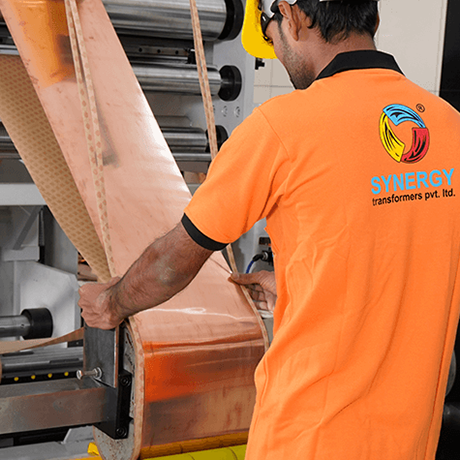
An objective analysis of material science, mechanical stress mitigation, thermal dynamics, and short-circuit withstand integrity in high-density aluminum foil windings.
Modern premium aluminum transformers strictly utilize EC-Grade (1350 Alloy) continuous foil or strip with an electrical conductivity exceeding 61.8% IACS. Continuous foil winding eliminates the localized hot spots, turn-to-turn insulation friction, and mechanical vulnerabilities associated with traditional round wire coils.
Aluminum exhibits a higher thermal expansion coefficient ($23 \times 10^{-6} / \text{K}$) compared to copper ($16.5 \times 10^{-6} / \text{K}$). However, by utilizing continuous sheet-foil winding, axial thermal gradients are flattened completely. Heat radiates across the entire width of the foil, reducing internal thermal stress during heavy load spikes.
During a network short-circuit fault, electrical coils experience severe electrodynamic axial forces. Foil-wound aluminum coils naturally eliminate axial magnetic unbalance because each turn extends across the entire length of the core window, distributing radial forces uniformly and preventing physical telescoping or coil deformation.
| Engineering Parameter | EC-1350 Grade Aluminum Sheet | ETP Electrical Copper Winding | Operational Sourcing & Design Impact |
|---|---|---|---|
| Electrical Conductivity | 61.8% IACS | 100.0% IACS | Aluminum requires ~1.56x conductor cross-section area to match thermal loss equivalent. |
| Conductor Mass / Density | 2.70 g/cm³ | 8.89 g/cm³ | Aluminum coils weigh ~50% less, reducing core structural load and transformer transport costs. |
| Axial Short-Circuit Force Distribution | Uniform (Sheet Foil) | Concentrated Crossovers | Foil-wound aluminum eliminates localized axial shear stress during network through-faults. |
| Bimetallic Joint Protection | Friction-welded Cu-Al Lugs | Standard Copper Lugs | Prevents galvanic corrosion at terminal connections under humid ambient conditions. |
| Capital Cost / Performance Ratio | Highly Economical (Stable) | High Volatility Premium | Aluminum provides up to 35-45% Capex savings per kVA without compromising thermal class rating. |

Our manufacturing center features automated precision foil winding machinery equipped with electronic edge alignment and automatic tension control. This guarantees zero edge deformation during high-speed coil winding.
For dry-type transformers, coils undergo high-vacuum pressure epoxy resin casting or VPI impregnation. This process eliminates microscopic air pockets, ensuring ultra-low partial discharge levels (< 5 pC) and achieving Class F (155°C) or Class H (180°C) thermal longevity under aggressive continuous ambient temperatures.
Consult Technical TeamKey industry shifts transforming transformer procurement for global utilities, EPC firms, data centers, and renewable energy developers.
Global utility procurement has evolved from evaluating upfront purchasing cost to calculating strict Total Cost of Ownership (TCO) over a 30-year lifespan. Buyers factor evaluated loss costs ($/Watt for No-Load and Load Losses) into bids. Aluminum foil transformers designed to low-loss loss standards (such as BIS Level 2 or EU Tier 2) offer optimal total capital performance.
Solar PV plants and offshore/onshore wind farms require specialized inverter duty transformers capable of handling severe multi-winding harmonics, rapid cyclic loading, and continuous DC bias current. Aluminum-wound step-up transformers with electrostatic copper shielding are increasingly favored to balance cost and grid resilience.
ESG mandates force procurement officers to audit the embodied carbon footprint of raw materials. Primary aluminum refining, when powered by clean hydropower or solar energy, produces significantly lower lifecycle carbon emissions per kVA rating compared to intensive copper mining and smelting processes.
Innovations in thermal insulation, smart online diagnostics, and structural miniaturization driving modern transformer engineering.
Historically restricted to Class B or F ratings, modern dry-type aluminum transformers utilize high-performance DuPont Nomex insulation sheets combined with specialized epoxy resin formulations. This allows transformers to operate safely at nominal hot-spot temperature rises of up to 125°C above ambient, accommodating extreme emergency overload conditions without insulating film breakdown.
Future-ready transformers integrate embedded fiber-optic hotspot temperature sensors, online partial discharge (PD) monitoring couplers, and digital oil dissolved gas analysis (DGA) transmitters. These telemetry sensors connect to central SCADA systems via MODBUS or IEC 61850 protocols, enabling predictive maintenance schedules.
Direct answers to core technical, quality control, and international logistics questions.
Submit your single-line diagrams (SLD), duty specifications, or project tenders. Our engineering team provides optimized technical recommendations, complete GTP drawings, and competitive direct factory pricing within 24 hours.
Contact Us