Explore our CSA-compliant, high-performance cast resin dry-type and oil-immersed transformers equipped with precision aluminum strip and foil winding technology. Sized for Hydro One, Toronto Hydro, and private industrial step-down grids.








As electrical infrastructure across the Greater Toronto Area (GTA)—spanning Downtown Toronto, Mississauga, Brampton, Markham, and Vaughan—undergoes massive modernization, utility engineers and EPC contractors face rigorous decisions regarding transformer core-coil architecture. Modern medium-voltage (MV) and low-voltage (LV) step-down applications demand an optimal balance between thermal resilience, short-circuit mechanical strength, footprint efficiency, and total cost of ownership (TCO).
While copper was historically regarded as the default conductor, advanced automated aluminum strip and foil winding technology has fundamentally transformed power distribution economics. For North American 60Hz distribution networks governed by CSA C22.2, CSA C802.1 / C802.2 energy efficiency regulations, and IEEE C57 standards, aluminum foil windings provide equal or superior thermal-mechanical performance compared to conventional wire-wound copper units at a substantially reduced capital expenditure.
In dense urban networks managed by Toronto Hydro or Hydro One, transformers are subject to elevated fault current levels due to low grid impedance and high short-circuit MVA capacities. Under through-fault conditions, conventional round-wire copper windings experience severe axial force imbalances at transposition joints, creating structural stress points that can deform insulation materials over time.
In contrast, our factory utilizes continuous precision aluminum foil coils. The geometry of a full-width aluminum sheet creates a balanced axial magnetic field across the entire winding structure. Radial forces are absorbed uniformally across the high-tensile insulation layers, resulting in near-zero net axial mechanical stress. This mechanical stability ensures long-term operational integrity even in heavy industrial facilities subject to frequent motor starting inrushes or arc furnace load surges.
The thermal behavior of aluminum windings offers specific physical advantages in high-density data centers (Markham/Mississauga tech corridors) and indoor high-rise substations. Aluminum possesses a higher specific heat capacity than copper (0.897 J/g°C vs. 0.385 J/g°C), enabling aluminum-wound transformers to absorb temporary load spikes with a slower rate of temperature rise.
Furthermore, because foil winding layers are separated by thin, high-dielectric Nomex or epoxy-impregnated insulation sheets rather than bulky wire insulation coats, heat generated within the core travels outward with lower thermal resistance. When combined with Vacuum Pressure Impregnation (VPI) or Cast Resin (SCB series) encapsulation, hot-spot temperature rise is suppressed below Class F (155°C) and Class H (180°C) thresholds, extending overall dielectric life beyond 30 years.
A historical concern among electrical engineers regarding aluminum conductors was joint relaxation and oxidation at terminal busbars. Our manufacturing facility resolves this through automated friction-welded bi-metallic (Cu-Al) transition pads and controlled inert-gas welding (TIG/MIG) under strict cleanroom conditions.
By executing aluminum-to-copper terminal connections inside the factory under monitored pressure and gas shield environments, we eliminate micro-voids and surface oxidation. Toronto installation crews connect incoming copper or aluminum cables directly to silver-plated copper pads without risk of galvanic corrosion, thermal creep, or contact degradation under cold winter-to-summer temperature cycling (-40°C to +40°C outdoor ambient range).
Operating from our 103,500+ sq. ft. precision manufacturing plant, every step of transformer production—from raw CRGO steel cutting to automated foil winding, core-coil assembly, tank fabrication, and final routine testing—is executed under a unified ISO quality system.
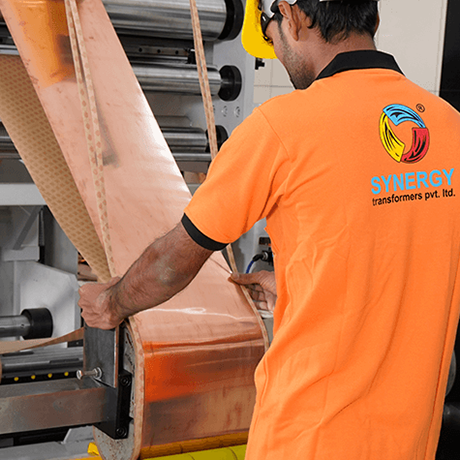
Our plant incorporates high-precision automatic aluminum foil winding machines with integrated edge-deburring, insulation tensioning, and electronic strip alignment. This guarantees zero layer displacement and uniform insulation strength throughout high-voltage and low-voltage coils.

We source cold-rolled grain-oriented (CRGO) silicon steel directly from top-tier global mills. Multi-step step-lap mitered core stacking minimizes magnetic flux leakage, reducing no-load losses to meet strict CSA C802 efficiency targets and Toronto Hydro green grid mandates.
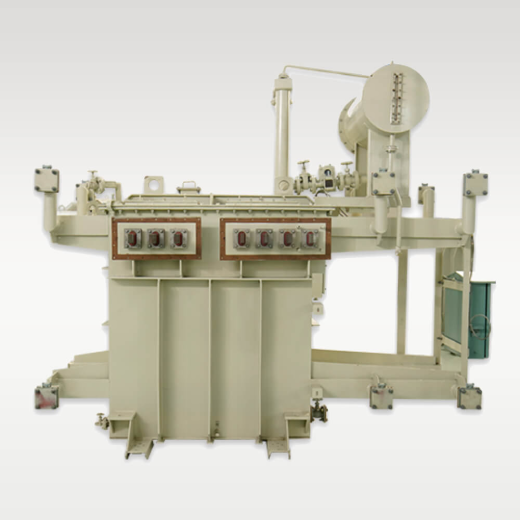
Every unit undergoes 100% routine inspection in our certified test bay: voltage ratio, vector group verification, winding resistance, insulation resistance, partial discharge monitoring, load/no-load loss verification, and high-potential separate source voltage withstand testing.
Designed to operate reliably under extreme North American climate conditions, our aluminum-wound transformers are configured for specific regional applications.
Compact cast resin dry-type transformers fitted into sub-grade urban vaults in Downtown Toronto. Self-extinguishing fire safety (F1 rating), low audible noise levels (<52 dB), and zero environmental liquid leakage risk.
K-Factor rated (K-13, K-20) aluminum foil transformers built to handle non-linear harmonic loads caused by large-scale server power supplies and uninterruptible power supply (UPS) system inversions without overheating.
Robust 44kV, 27.6kV, and 13.8kV step-down substations deployed across Hamilton steel mills, Oshawa automotive plants, and Vaughan industrial complexes, providing extreme short-circuit withstand during motor start cycles.
Quick-reference selection guide for engineering consultants, electrical master contractors, and procurement executives.
| Product Family | Power Rating | Primary Voltage (HV) | Secondary Voltage (LV) | Cooling / Class | Compliance Standard |
|---|---|---|---|---|---|
| Cast Resin Dry-Type | 315 kVA – 4500 kVA | 4.16kV / 13.8kV / 27.6kV / 44kV | 208Y/120V, 480V, 600Y/347V | AN / AF, Class F/H | CSA C22.2 No. 47, CSA C802.2 |
| Oil-Immersed Substation | 500 kVA – 30 MVA | 13.8kV up to 69kV | 2.4kV, 4.16kV, 13.8kV | ONAN / ONAF, Mineral/Bio-Oil | IEEE C57.12.00, CSA C802.1 |
| K-Factor Data Center Unit | 500 kVA – 3150 kVA | 13.8kV / 27.6kV | 415V / 480V / 600V | Cast Resin / VPI (K-13 / K-20) | IEEE C57.110, CSA C22.2 |
| Low Voltage Isolation | 15 kVA – 630 kVA | 480V / 600V | 208Y/120V, 380V, 415V | Self-Cooled Dry Type | CSA C22.2 No. 47, CE |
Essential answers regarding technical standards, delivery logistics, and lifetime performance in Ontario.
Submit your project single-line diagram (SLD), voltage rating requirement, or transformer specification sheet. Our senior application engineers provide rapid technical reviews, loss evaluations, and competitive factory pricing within 24 hours.
